
Ryanair Flying Out of Bournemouth for the Winter Sun Season 2013
Ever since the Spanish conquest of Tenerife there have been extensive periods of emigration from the island, usually coinciding with economic downturns. Ships have always used the Canaries as a stopover on voyages between Europe and the Americas, making it easy to book a one way passage.
The most popular destination was Latin America where Spanish is widely spoken. Cuba was one of the earliest destinations of the Canarian emigrants, where they played an important part in the development of the capital city Havana, and of the famous cigar making industry.
In the eighteenth century several families left Tenerife and ended up founding the city of Montevideo in Uruguay, and the towns of San Antonio in Texas and San Bernado, Louisiana, USA.
When the Spanish civil war broke out in 1936, there was renewed emigration due to poor living conditions and the fear of reprisals, but this time the destination was mainly Venezuela due to its promising economic outlook.
The outbreak of WW2 led to the collapse of Tenerife’s economy as access to foreign markets was denied, and many thousands left the island in search of a better life. These included politicians, intellectuals, scientists, writers and artists, who were being persecuted by the Franco military regime, and went into voluntary exile. Many of them set up organisations in their adopted countries to fight for freedom and the restoration of democracy to Spain.
This migration continued up to the 1970’s, but had stopped almost completely by the mid 1980’s due to rampant economic development caused by the new booming tourist industry.
These days, with the continued growth of tourism and the prosperity this brings, there is a reversal of this migration, with many of the migrants and their descendants returning to the Tenerife, especially from Venezuela. There has also been a large immigration of people from northern Europe seeking to escape the cold weather and live in a warm sunny climate.
In April 1657, The Royal Navy, under the command of General at Sea Robert Blake, won a devastating victory over the Spanish at Santa Cruz de Tenerife in the Canary Islands during the Anglo Spanish War of 1654-1660. This defeat for the Spanish, the biggest since the loss of the armada in 1588, left the countries finances in ruins and forced her to abandon plans to invade Portugal.
The British had been at war with the Spanish since 1654, and Oliver Cromwell as Lord Protector had plans to capture the Spanish colonies in the West Indies. Part of this plan involved the capture of the Spanish silver bullion Treasure Fleet that sailed across the Atlantic every year between Spain and the Americas.
The capture of this fleet would cripple Spain financially ending its war effort, and at the same time boost the finances of the Commonwealth of England.
Blake set sail with his fleet of 46 ships in the spring of 1656, heading for the Spanish coast, but much to his frustration the Spanish refuse to do battle. He responded by sailing to the port of Cadiz in southern Spain, where the British blockaded the port for the winter of 1656-57 with the intention of intercepting the Spanish bullion treasure fleet.
The Spanish bullion fleet realised they could not enter the port of Cadiz because of the blockade, so the fleet was ordered to sail to the port of Santa Cruz de Tenerife in the Canary Islands, with the intention of completing the voyage under escort when it was safe to do so.
Blake received intelligence the bullion fleet was waiting in Tenerife and set sail immediately, arriving off the coast of the island on 18th April. After deliberating with his captains, it was decided they would attack the Spanish flotilla anchored inshore with 12 of their ships, with the remainder waiting further out to sea.
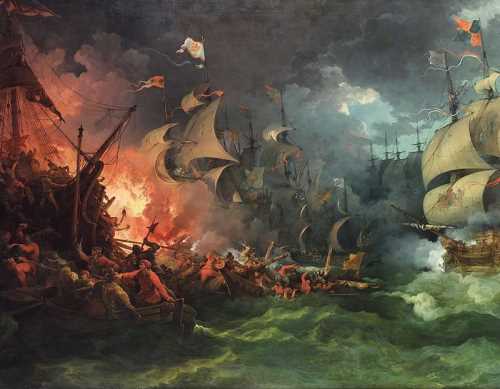 Spanish Armada
The British ships faced a formidable task; the port of Santa Cruz was heavily defended by gun batteries on shore, and the Spanish war ships were formed in line to be able to fire broadsides at the British as they approached. They nethertheless managed to enter the harbour and get between the lines of Spanish ships, destroying or capturing all the Spanish ships.
The Spanish had made a serious error by placing their inner line of ships between the batteries and the English. Five Spanish ships were taken as prizes and were taken under tow out of the harbour but it was extremely difficult to get them out to sea, and the unpopular decision was made to set them on fire and abandon them, with the loss of prize money for their capture for the crews.
The English ships all escaped with only one suffering heavy damage, but the major disappointment was the failure to capture the silver bullion, which the Spanish had moved ashore and hidden.
Blake was hailed a national hero in England, but died on the homeward journey when his ship was within sight of Plymouth, and was buried in Westminster Abbey with a full state funeral.
The Spanish now had no means of transporting the silver bullion from Tenerife to Spain, and the lack of finance fatally undermined her position in Portugal and Flanders. The victory also established England as a major sea power.
Christopher Columbus, the Italian explorer and discoverer of the New World, had many connections with the Canary Islands.
In August 1492, Columbus set sail from southern Spain to find a western route to the Indies, and also to prove the world was round, as many Catholic Theologians at the time were still insisting it was flat. Most educated Europeans however, had realised the world was in fact round since Aristotle’s work in the 4th century.
He first sailed to the Canary Islands, stopping at San Sebastian on La Gomera for provisions before setting out on the five week voyage across the Atlantic, where he discovered the Americas.
Columbus also came here to visit Beatriz de Bobadilla, who had been a mistress of king Ferdinand of Spain, with whom he had a romance and stopped here on his first three transatlantic voyages.
By the time of his fourth voyage Beatriz had married one of the islands most powerful men, so he wisely gave La Gomera a miss.
Columbus reportedly witnessed the volcano Mount Teide erupting on the island of Tenerife on his first voyage across the Atlantic in 1492, where he saw "a great fire in the Orotava Valley". It is apparent from carbon dating there was no eruption that year in the Orotava Valley, but there was from the Boca Cangrejo vent on the Santiago rift.
Searching for Sugar Man
The ‘Dracaena Draco’ to give it its proper name, is a native species to the Canary Islands, and is used as an official plant symbol of Tenerife.
The Dragon tree get its name from the red sap the tree produces, and is known as dragon’s blood. This red resin was used in ancient times as a dye, used in medication and wound healing, as well as warding off evil spirits.
The sap was also believed to be cure leprosy and was for time exported to Italy to stain violins and marble. In medieval times this red sap was claimed by some encyclopaedias to literally be the blood from dragons that had been slain in combat.
The most famous and the oldest dragon tree on Tenerife is located in the town of Icod de los Vinos on the islands northern side. The tree is believed to have been used by the native Guanche people as a place to hold important meetings.
This tree is reputedly over 1000 years old and is known as El Drago Milenario (The Thousand Year Old Dragon), although these claims are unsubstantiated as the trees are difficult to age; this mighty tree stands 22m high with a diameter of 22m.
In 1993 a road that ran a few meters from the tree was rerouted, and the tree now stands protected in its own park setting. The city council has tried twice to have to tree listed as a UNESCO World Heritage Site in 2002 and 2011.
The trees species are a remnant from the Tertiary period and have survived the ice age where the only places warm enough for them to grow were the Canary Islands, Cape Verde Islands and Madera.
Dragon Trees are actually classed as monocots, so they are not real trees at all, but in fact belong to the same family as asparagus.