The town of San Cristóbal de La Laguna on Tenerife in the Canary Islands was founded in 1497 by Alonso Fernández de Lugo, and gets its name from the shallow lake that was there and was subsequently drained in 1837.
The town has two historical centres, the original upper town (Villa de Arriba) of 1497, and the lower town (Villa de Abajo) of 1502. These areas were laid out according to philosophical principles of the time, having open spaces and wide streets. There are buildings dating back to the 16th century and it was the first non fortified colonial Spanish town, whose layout was copied by many colonial towns in the Americas.
The original inhabitants where nearly all soldiers and they did not get allocated plots of land to build on. Instead the area was considered to be public land on which any one could build. This resulted in haphazard construction around the church of La Concepción.
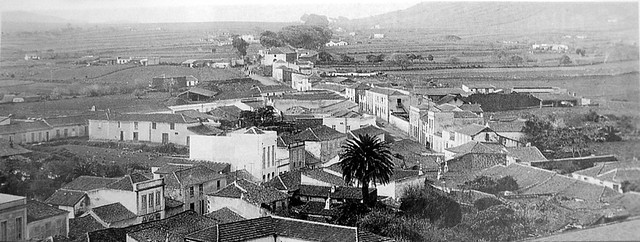 La Laguna Tenerife Villa de Arriba 1910
A town plan was created in 1502 based on Leonardo da Vinci's map of Imola. Wide streets were created linking open spaces for the public, forming a grid layout on which smaller streets were later superimposed. This resulted in the rapid expansion of the Lower Town that attracted the ruling classes and monastic communities and had more than 1000 inhabitants by 1515.
 La Laguna was based on Leonardo da Vinci's map of Imola
In 1521 a piped water supply was installed by the town council and the first public buildings were built in 1525. The town was granted official urban status in 1531. By 1555 the town’s population had risen to 6000, the largest in Canary Islands at that time, and due to the risk of fire the town council ruled that any houses made of straw must be demolished.
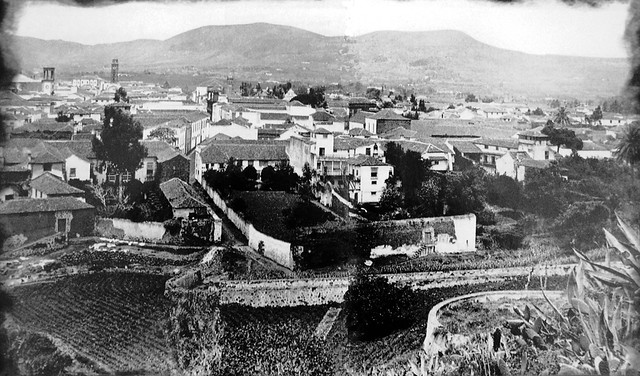 La Laguna desde San Roque Tenerife 1902
San Cristóbal remained the main commercial, political and religious centre during the 17th and 18th centuries, and this prosperity is reflected by the building from the period that still remain. But over time the economic, political and religious centre was slowly transferred to Santa Cruz and San Cristóbal went into decline.
The town recovered some of its role during the 20th century mostly due to the prestige of its university.
Las Gaviotas beach is situated north of Santa Cruz de Tenerife, 1km from the beach of La Teresitas, although it is 6 km by road. The beach is a small black sand beach set underneath cliffs and is accessible by road only.
To get to the beach follow the TF-121 road from San Andreas towards Igueste de san Andrés. There is a road on the right sign posted ‘Las Gaviotas’, this narrow road winds down under the cliffs to a small car park at the beach.
The bus line 945 stops here, but you will have to walk down Calle las Gaviotas to get to the beach.
The beach is a popular nudist beach. It also has a drinks shack on the beach selling refreshments.
Tenerife is now known as a World class diving destination; with divers visiting from many different countries. There are many unexpected wonderful sights for the visiting diver to discover. Whales and Dolphins can be seen offshore. Angel sharks mate during the months of March and April, and can be spotted in shallow waters. Black Atlantic stingrays and other species of Ray will be seen on most dives, and especially in the area of Los Gigantes in the South of Tenerife.
There is a dive centre in Los Gigantes, this is the only dive centre working exclusively with the Seahorse Trust in Tenerife. Seahorses are very rare but have been seen off the coast of Los Gigantes by the Dive Centre. Octopus Cove is the home of seahorses, and during the summer months there appear to be a number of these little mystical creatures around. Usually you can only see seahorses in aquariums in places like Loro Parque in the North of Tenerife.
With very clear visibility, a warm sub-tropical climate, and an extremely large impressive collection of marine life, divers can enjoy all year round diving. The volcanic Island of Tenerife rises from the deep Atlantic Ocean floor. Divers can explore the enormous entrances of the volcanically formed caves that make up some of Tenerife's underwater wonders.
There are not lots of wrecks, but there is an intact wreck of a passenger aircraft in 30 Meters that had to ditch into the ocean after encountering difficulties on take-off. There are some ship wrecks around the coast line and these are often visited by large pelagic fish.
Below are a few examples of dive sites around Tenerife, although there are many more to choose from.
Playa Paraisso offers most certified divers the opportunity to see a variety of Rays, and an old anchor which has been left behind from a ship. Atlantic, Bull, and Eagle rays can be seen on this dive.
There is a Canarian fishing village on the South West coast of Tenerife, called El Puertito. The site has been cleared of sea urchins and rubbish, and Greenback Turtles were introduced to the site. This project was successful, and later on the turtles had babies. This is an interesting dive not to be missed. The turtles are very friendly, and will come over to see the divers.
In the South of Tenerife, is Palm Mar Cave. This is a boat dive with a maximum depth of 32 Meters. A statue of Virgin Del Carmen can be seen on this dive. If you head towards the cave, the rock walls of the cave are stunning. You cannot enter the cave as it is not permitted, however you will see Moray Eels and Tiger Moray Eels around the entrance to the cave. It is common for a Ray or two to appear gliding across the sand.
Puerto de la Cruz Night Life Review
Puerto de la Cruz night life centres around the cafés and restaurants of the various districts of Puerto de la Cruz. Some of the restaurants on the sea front in the new town have live entertainment in the form of singers with electric pianos, Spanish dancers etc. The promenade and old town of Puerto de la Cruz are thronging with people at night, and there are many street entertainers and African street traders selling their wares.
The second Arona Summer Festival starts today at the Olympic Stadium, Playa de las Americas. It follows on from last year successful event starting at 18:00.
The event brings dance music from around the world as well as from the Canary Islands from 15 different artists.
There will be music from Jamaican artist Sean Paul, Australian Twins ‘Nervo’ and the brothers Dimitri Vegas and Like Mike.
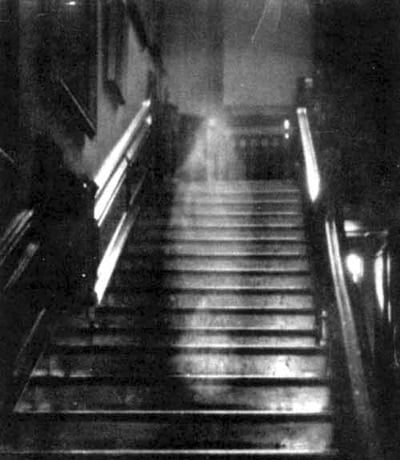
In the Town of La Laguna is the Museum of History and Anthropology of Tenerife. This is situated in the “Casa Lercaro“, and was once a fine mansion. Back in November 2003 a Spanish newspaper ran a story about a ghost in the museum. The staff wanted to remain anonymous when talking about the ghost, as they were frightened of losing their jobs. Tenerife does not like to promote its historic buildings with ghosts. La Laguna Council want to keep quiet about this young lady Catherine, or Catalina in Spanish, who they say haunts the museum.
The 16th century house in San Augustine Street was owned by the wealthy Lercaro family. Catalina’s father, Antonio Lercaro, forced her to marry an older man. On the day of the wedding Catalina threw herself down a well at the back of the mansion. She was so unhappy about the marriage, and felt that there was no other way out. This made her take her own life.
The story goes that her remains are hidden in one of the rooms in the house. The church would not allow Catalina’s body to be buried in the cemetery because she had committed suicide. The well was boarded up, and the family moved away to La Orotava.
A young woman has reportedly been seen in the Museum, and mysterious footsteps have been heard. The forgotten Catalina haunts this museum in La Laguna.